
Where to Play
Best Golf Courses in Scottsdale & Paradise Valley
Two Coore and Crenshaw courses, a desert-links rebuild and resort golf beneath Camelback Mountain
Updated · November 17, 2026
Central Scottsdale and Paradise Valley hold six public courses and one private club, and most of the golf here is not the target-style desert golf the area is known for. Talking Stick's O'odham and Piipaash courses are Coore and Crenshaw designs on Salt River Pima-Maricopa Indian Community land. Camelback Golf Club pairs Ambiente, a links-style rebuild, with Padre, a lake-lined parkland course. McCormick Ranch's Palm Course is a 1972 water course, and The Phoenician runs its 18 into the base of Camelback Mountain. This guide to the Scottsdale & Paradise Valley region is for golfers who would rather play near a central Scottsdale hotel than drive north, and who prefer grass and angles to carries over open desert.
Talking Stick Golf Club
The Salt River Pima-Maricopa Indian Community owns and runs Talking Stick. Both courses opened in 1998 as Bill Coore and Ben Crenshaw designs, among the firm's first major public-access desert courses, the club says. The North and South courses were later renamed for the Community's two peoples, the Akimel O'odham (Pima) and the Xalychidom Piipaash (Maricopa). The architects were asked for two different playing characters, and playing both is the clearest design lesson in central Scottsdale. Walking is allowed on both.
O'odham Course
O'odham is open and low to the ground. The fairways are wide and angular, there are no artificial lakes, and the slightly crowned greens sit behind close-cut approaches that accept a running shot as readily as a high one. Par is 70 and the Black tees stretch to 7,001 yards, yet its 124 slope is the lowest in this guide, which tells you where the interest lies: in picking angles, not in surviving punishment. GOLF Magazine ranks it No. 10 in its Best Golf Courses in Arizona 2024-25, a list that includes private clubs, and Golfweek's Best 2026 has it No. 47 among the top 50 casino courses in the U.S.
Piipaash Course
Piipaash is the other half of the lesson. Eucalyptus and cottonwood line its fairways, a few water features come into play, and the raised greens are guarded at the sides by bunkers and slopes. The club calls it what-you-see-is-what-you-get golf, built for an aerial game; miss a green and the recovery comes from sand or from below the putting surface. It measures 6,725 yards at par 71 (72.0/126) and is tied at No. 48 on the same Golfweek list.
Camelback Golf Club
Camelback Golf Club is the golf operation of the JW Marriott Scottsdale Camelback Inn, 3.5 miles from the hotel, and the resort runs a shuttle over. Hotel guests get a 30-day head start on the tee sheet. The club's two courses have almost nothing in common, which is the reason to play both.
Ambiente Course
Ambiente is the stiffer course and the more interesting one. It began as the old Indian Bend course, so flat that it flooded, until Jason Straka of Hurdzan/Fry rebuilt it completely; it reopened in November 2013. Straka lowered and naturalized the Indian Bend Wash, used the spoil to put movement into the holes and cut maintained turf from 210 acres to about 90. The result is a links-flavored, out-and-back round, with native grasses where turf used to be and deep, tall-faced bunkers, some 30 to 50 yards short of the greens, doing most of the defending. Links-style public golf is rare around Phoenix, and the look is northern desert rather than the area's usual Sonoran. From the Black tees it plays 7,225 yards (74.2/138), the highest rating and slope in this guide, and Golfweek's Best 2026 ranks it No. 28 among Arizona courses you can play.
Padre Course
Padre is the opposite. Golf Channel called it one of the few purely parkland courses in Scottsdale, and it looks it, with towering pines and eucalyptus, lakes and lush turf on ground about as flat as golf gets. Arthur Hills gets the design credit from the club, and by Golf Channel's account his redesign dates to 1999. Arizona Golfer counts water on nine holes, all four par 5s among them, and the greens carry false fronts and sides, so the trouble arrives on the approach rather than off the tee. At 6,868 yards (72.2/130) it is the gentler of the pair, and the better pick for a golfer who would rather play over grass than over desert.
The Phoenician Golf Club
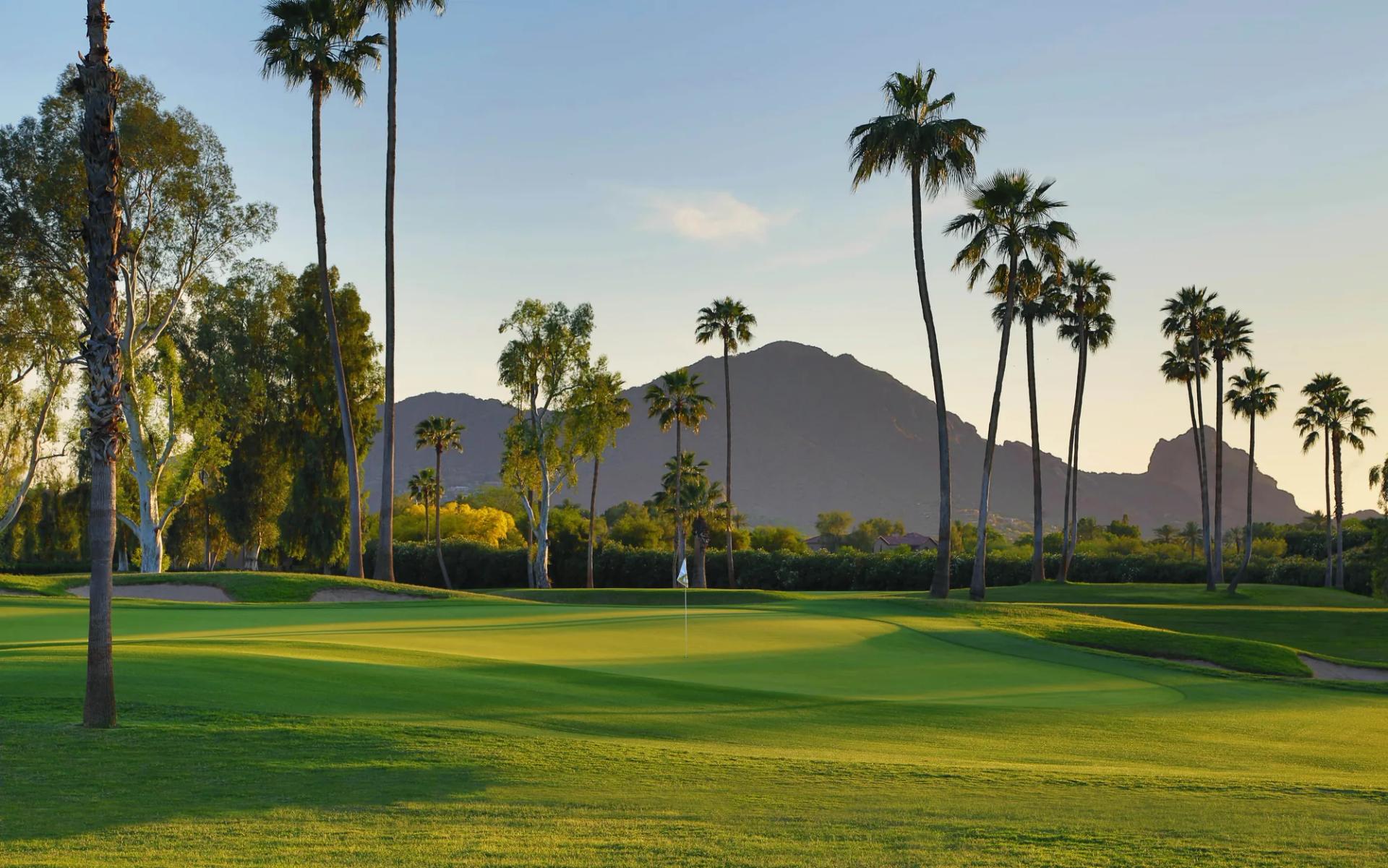
The Phoenician's course belongs to the resort of the same name, a Luxury Collection property at the base of Camelback Mountain. Troon manages it, and it takes daily-fee players as well as resort guests. In 2018 Phil Smith, a Scottsdale architect and longtime design partner of Tom Weiskopf, spent 10 months turning the resort's 27 holes into one 18. Working within the old fairway corridors, he rebuilt the greens and their surrounds, and the new 18 opened on November 1, 2018. Smith wanted a player to see everything before each shot, so there are no blind shots or hidden hazards, and the back nine winds into the foot of the mountain. It measures 6,352 yards from the Players tees (par 71, 70.5/128). Play it for the setting and the chance to score; length is not the point.
McCormick Ranch Golf Club: the Palm Course
The Palm is the least resort-like round in the region. McCormick Ranch Golf Club is a 36-hole public club in the heart of Scottsdale, owned by the same family since 1979 and, it says, open 365 days a year. Desmond Muirhead designed it, and it opened in 1972 on part of the old McCormick ranch. Water is in play on 10 holes, and the club's signature is the 9th, with an island landing area and a peninsula green. Watch the greens as closely as the tee shots: several slope sharply from back to front, and the 5th has three tiers. A regrassing and bunker project with a drought-tolerant hybrid Bermuda finished the front nine in 2024, with the back nine still to come, and the club says the layout stays largely the same. From the Blue tees it plays 6,951 yards (73.2/132), with Camelback and the McDowell Mountains in view.
Which to play
With one round, play O'odham, for the way Coore and Crenshaw made flat, open ground interesting. With two, add Ambiente, the stiffest test here and the most unusual look. Padre and the Palm suit golfers who want water and trees rather than sand and scrub, and The Phoenician is the pick when the setting matters more than the yardage. For classic desert golf with carries over native ground, head to North Scottsdale or Fountain Hills instead. The North Scottsdale guide and the Fountain Hills guide cover them, and the region-by-region Scottsdale guide has the whole market.
The private club
Paradise Valley Country Club is a private club for members and their guests; there is no way to book it. Member-owned, it sits beneath Camelback Mountain in the town of Paradise Valley and dates its membership to 1953. The course is parkland in style, and the club credits its most recent redesign and renovation to Coore and Crenshaw, which puts the firm's name on a third course in this small region. Golfweek's Best 2025 ranked it No. 16 among Arizona's private courses.
How to book
The public courses here take tee times through GolfNow or their own tee sheets, and each course page links the right one; we don't sell tee times. Camelback's sheet opens 60 days out to the public and 90 to Camelback Inn guests, and The Phoenician takes both daily-fee and resort play. Paradise Valley Country Club is for members and their guests only. Desert golf peaks from roughly October to April. Most desert courses overseed in early fall and close or play temporary greens for a few weeks, so check with the course before an early-fall round; when to golf in Scottsdale has the detail. For access rules, see how to play golf in Scottsdale; for more bookable golf, the best public courses in Scottsdale and Phoenix and the best resort golf.